
Replace one or more missing teeth with dental implants planned around your bone health, bite, function, and long-term restorative needs.
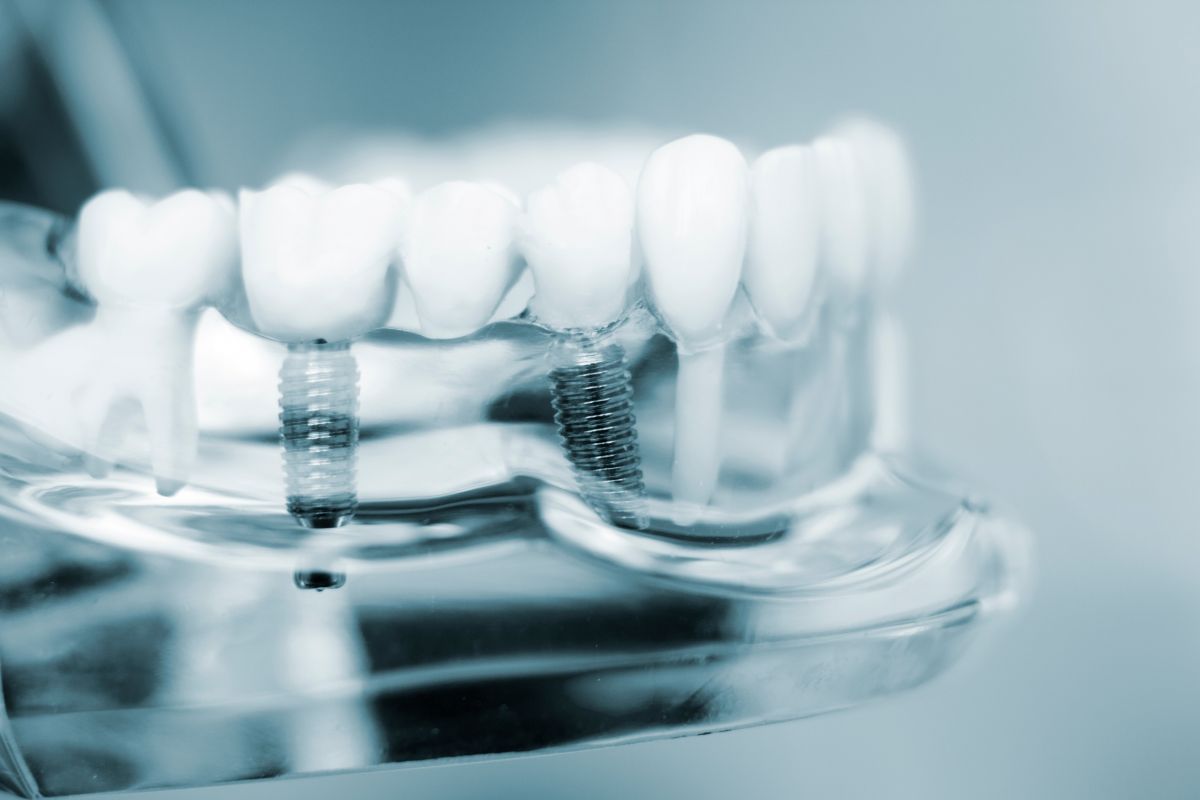
A dental implant is a small biocompatible titanium or ceramic post placed into the jawbone, where it fuses with the bone over several months to act as an artificial tooth root. A custom-matched crown is then attached, giving you a replacement tooth that looks, feels, and functions like your natural one.
Unlike a dental bridge, an implant doesn't rely on neighboring teeth for support. And unlike dentures, an implant stimulates the jawbone the same way a natural tooth root does — important because implant-supported tooth replacement can help preserve stimulation to the jawbone after tooth loss. Read more in our guide to the ABCs of dental implants.
At 12 Oaks, we place both traditional titanium and metal-free ceramic implants. For a side-by-side look at implants versus another popular option, see our article on dental implants vs. veneers.
A missing tooth changes more than your smile — it changes your bite and, over time, your jawbone density. Before recommending an implant, we evaluate the whole system, not just the gap.
Here's what we're evaluating before we recommend treatment.
Without a tooth root stimulating it, the jawbone begins to resorb — often within months.
Neighboring teeth drift into the open space, throwing off your entire bite alignment.
As your bite shifts, remaining teeth absorb forces they weren't designed for.
Tooth loss and bite collapse can affect jaw position and, in some cases, airway space.
Difficulty chewing can lead patients to avoid whole foods, affecting nutrition over time.
Gaps affect speech and self-consciousness — real quality-of-life factors we take seriously.
Implants stand independently, preserve bone density, and don't require altering healthy neighboring teeth.
A dental bridge or denture may be the better fit depending on your bone health, budget, or number of missing teeth.
Most cases take 3 to 8 months from placement to final crown, primarily due to healing time.
3D imaging plus a full bite, airway, and bone density review to determine candidacy.
The implant post is placed under local anesthesia (sedation options available).
Over roughly 3 to 6 months, the implant fuses with your jawbone.
A custom-matched crown is attached, completing a natural-functioning restoration.
We check bite alignment and monitor the implant at follow-up visits.
Before recommending an implant, we want to understand why the tooth was lost — grinding, untreated decay, gum disease, or trauma — because that root cause needs to be addressed too, or it can compromise the implant's long-term success. Read a real patient story in bringing new life to a dead tooth.
We also take material choice seriously, offering ceramic (zirconia) implants alongside traditional titanium for patients who prefer metal-free dentistry — part of the same whole-body dentistry philosophy behind everything we do.
Because an implant becomes a long-term part of your bite, we evaluate your full bite mechanics and airway before placement — not after problems appear.
Schedule a Complete Health ConsultationTreatment fees vary from person to person because every case is different. Before treatment begins, we explain your options, review any applicable insurance benefits, and provide a clear, personalized estimate so you know what to expect.
11623 Angus Rd, Bldg D, Suite 16, Austin, TX 78759
Near the Arboretum and Domain. Serving Round Rock, Cedar Park, Pflugerville, Brushy Creek, Downtown Austin, Bee Cave, Lakeway, West Lake Hills, and Georgetown.